
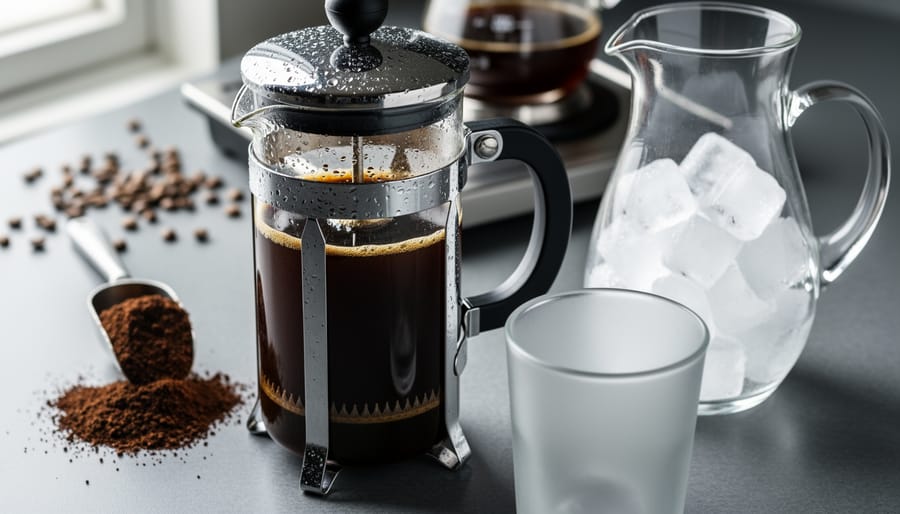
Making cold brew coffee in a French press takes the equipment you already own and transforms it into a smooth, low-acid concentrate in about 12 to 16 hours. The process is simple: coarsely ground coffee steeps in cold water overnight, then you press and strain as usual. Unlike traditional hot brewing methods, cold extraction pulls fewer bitter compounds and oils from the beans, resulting in a naturally sweeter, mellower cup that highlights chocolate and fruity notes while minimizing acidity.
The beauty of this method lies in its forgiveness. You won’t burn the coffee or over-extract it with incorrect water temperature because there’s no heat involved. The French press design works perfectly for cold brewing since the mesh filter catches grounds while allowing the clean concentrate through. Many coffee shops charge premium prices for cold brew, but you can make a week’s supply at home for the cost of a single café serving.
I’ve been using this technique since 2019, and it’s become my go-to preparation during warmer months. The concentrate stores in your refrigerator for up to two weeks, ready to dilute with water, milk, or pour over ice whenever you need a quick caffeine fix. Whether you’re new to French press brewing or looking to expand your cold coffee repertoire, this straightforward approach delivers consistently excellent results without specialized gear or complicated ratios to memorize.
Why Cold Brew in a French Press Works So Well
Cold brewing extracts coffee completely differently from hot methods, and that difference makes all the difference in your cup. When you steep coffee grounds in cold water for 12 to 24 hours, you pull out the smooth, sweet compounds while leaving behind most of the acids and bitter oils that heat releases. The result? A concentrate that’s naturally low in acidity and free of the harsh bite you sometimes get from hot-brewed coffee that’s gone cold. This slower extraction process is gentler on the beans and produces a completely different flavor profile, think chocolate notes and natural sweetness rather than sharp brightness.
Here’s where the French press shines: its mesh filter is perfectly suited to handle cold brew’s coarse grind and thicker body. Unlike paper filters that can strip away the oils that give cold brew its characteristic smoothness, the metal mesh lets those flavorful compounds through while still catching the grounds. You’re getting full-bodied cold brew without any specialized equipment. The wide chamber makes stirring easy to ensure every ground gets saturated, and the plunger mechanism gives you control over the final press to minimize sediment.
The practical benefits seal the deal. A French press you already own becomes a cold brew maker for zero additional investment, while dedicated cold brew systems typically run $25 to $100. Cleanup takes about sixty seconds, rinse the carafe, wash the plunger, done. You can also scale your batch size to match your French press capacity, whether that’s a small 350ml press for personal batches or a full liter for sharing. The coarse grind required for cold brew is actually coarser than standard French press hot brewing, which makes the final plunge even easier and reduces the fine sediment that sometimes clouds hot-brewed French press coffee.
What You’ll Need: Tools and Materials
You’ll need surprisingly little to make exceptional cold brew in your French press, and chances are you already own most of these items. The beauty of this method is that it doesn’t require specialized equipment or a significant investment.
Here’s your complete equipment list:
- French press (any size works, though 34oz/1-liter models are ideal for batch brewing)
- Fresh coffee beans (medium to dark roasts work particularly well for cold brew)
- Burr grinder (blade grinders can work in a pinch, but consistency matters)
- Cold filtered water (tap water is fine if yours tastes good)
- Digital kitchen scale (accurate to 1 gram)
- Long spoon or mixing utensil for stirring
- Serving glass or pitcher for the finished concentrate
The French press itself is the star here. Any French press you own will work, whether it’s a 12oz single-serve model or a large 51oz version. A 34oz press hits the sweet spot for most cold brew batches, yielding enough concentrate for several servings without taking up too much refrigerator space. Glass models are traditional and let you monitor the brew’s color, while stainless steel versions offer better insulation if you’re steeping at room temperature.
Your coffee scale is non-negotiable for consistent results. Eyeballing measurements works for some cooking, but cold brew ratios need precision to achieve the right strength. A basic digital scale that measures in grams will serve you well.
For the burr grinder, consistency in grind size directly impacts your extraction and how easily the plunger presses. Blade grinders produce uneven particle sizes that can lead to over-extraction of fines and under-extraction of larger pieces, though they’ll suffice if that’s what you have. If you don’t own a grinder at all, buy pre-ground coffee specifically labeled as coarse grind, or ask your local roaster to grind beans for French press.
Understanding the Cold Brew Ratio and Grind Size
Getting your ratio and grind right makes the difference between weak, watery cold brew and a rich concentrate you’ll actually want to drink. Cold brew ratios work completely differently from hot coffee, and understanding this upfront saves you from frustration and wasted beans.
For cold brew concentrate in a French press, you want a 1:5 coffee-to-water ratio by weight. That means 1 gram of coffee for every 5 grams of water. In practical terms, if you’re using a standard 34-ounce French press, you’d use 70 grams of coffee to 350 grams of water, which produces about 12 ounces of concentrate after pressing. This yields a strong base that you’ll dilute with water, milk, or ice when serving, typically in a 1:1 ratio, giving you roughly 24 ounces of ready-to-drink cold brew from one batch.
If you prefer ready-to-drink cold brew instead of concentrate, adjust to a 1:8 ratio, which lets you pour and drink straight from the press without dilution. For smaller or larger French presses, scale proportionally: a 17-ounce press works well with 35 grams coffee to 175 grams water, while a 51-ounce press can handle 105 grams coffee to 525 grams water for concentrate.
Grind size matters just as much as ratio. You need a coarse grind for cold brew, similar to what you’d use for hot French press coffee but potentially even slightly coarser. Think coarse sea salt or breadcrumbs rather than sand. The reason comes down to extraction time and filtering. Since you’re steeping for 12 to 24 hours instead of the 4 minutes standard for hot French press, a coarse grind prevents over-extraction and bitterness while still allowing enough surface area contact for flavor development. A coarse grind also makes pressing significantly easier and reduces sediment in your final cup, since finer particles slip through the mesh filter and create muddy coffee.
Step-by-Step: How to Make Cold Brew Coffee in Your French Press
Step 1: Grind Your Coffee Beans
Start with whole beans and a burr grinder set to its coarsest setting. You’re aiming for a grind that resembles raw sugar or coarse sea salt, chunky, distinct particles rather than fine powder. If your beans look like breadcrumbs, you’ve gone too fine.
Coarse grind is critical for cold brew because the long 12-24 hour steep time means more surface area exposed equals over-extraction and bitterness. Larger particles also prevent the French press mesh from clogging, making the final press smooth and keeping sediment out of your cup. When you run the grounds between your fingers, you should feel individual granules, not a uniform grit. Grind just before you start; fresh-ground coffee gives noticeably brighter flavor even in cold extraction.
Step 2: Add Coffee to Your French Press
Once you’ve ground your coffee, transfer the grounds directly into a clean, dry French press. There’s no need to rinse or pre-wet the carafe for cold brew, dry grounds actually absorb water more evenly during the initial pour. Simply tip or spoon the 70 grams of coarse grounds into the empty French press, making sure they settle in an even layer at the bottom. If you’re scaling the recipe up or down, adjust proportionally but keep the carafe no more than two-thirds full once water is added, leaving room for the plunger mechanism to fit comfortably without overflowing.
Step 3: Add Cold Water and Stir
Pour your cold filtered water directly over the coffee grounds, filling to your French press’s capacity or your target ratio. Cold water, ideally filtered to remove chlorine and impurities, extracts flavor more gently than hot water, which is why cold brew tastes smooth rather than sharp. Once you’ve added all the water, use a long spoon or chopstick to stir thoroughly for about ten seconds, ensuring every clump breaks up and all grounds are fully saturated. You’ll notice some grounds float at first; a good stir pulls them under the water where extraction happens. Avoid stirring too vigorously or splashing, which can introduce air bubbles and create uneven extraction. If you see dry pockets of coffee sitting on top after stirring, give it one more gentle mix, those unmoistened grounds won’t contribute flavor and will just waste your coffee.
Step 4: Steep for 12-24 Hours
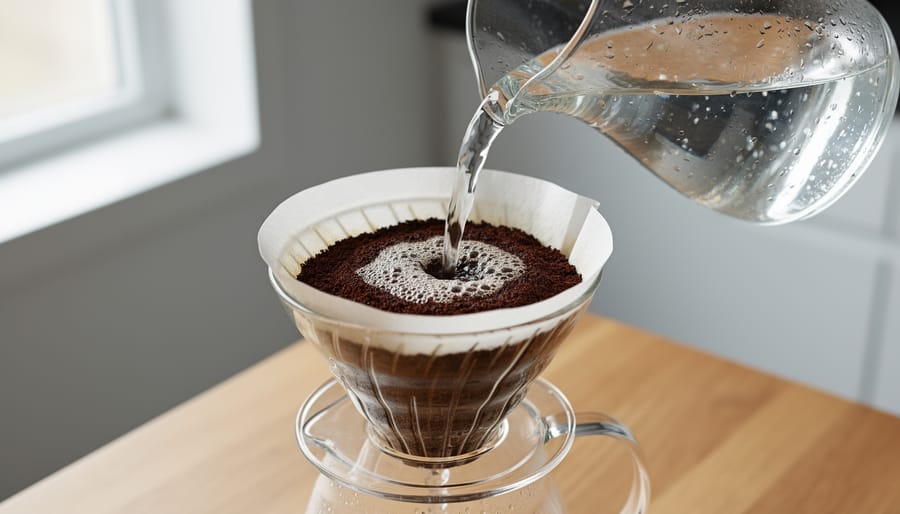
Once you’ve stirred the coffee and water, it’s time for the magic to happen, and that magic requires patience. Place the lid and plunger assembly on top of your French press, but don’t press down yet. Leave the plunger in the fully raised position so the grounds can steep freely in the cold water.
Store your French press in the refrigerator for the entire steeping period. While some people steep at room temperature, refrigeration produces cleaner, more consistent results and reduces the risk of bacterial growth, especially in warmer climates. Find a stable spot where the press won’t get knocked over.
The standard steeping window is 12-24 hours, and this range matters more than you might think. At 12 hours, you’ll get a lighter, more delicate cold brew with subtle sweetness and bright notes. Pushing toward 18 hours delivers a well-rounded, balanced concentrate that most people prefer. The full 24 hours produces the boldest, most intense flavor with maximum caffeine extraction, though you risk pulling some bitterness if your beans skew darker.
Here’s an insider tip: start with 16 hours for your first batch, then adjust by two-hour increments in future brews based on whether you want more or less intensity. Mark your steep time on your phone or a sticky note, it’s easy to forget when you started. Once you find your sweet spot, stick with it for consistent results every time.
Step 5: Press the Plunger Slowly
After your cold brew has steeped for 12-24 hours, it’s time to press, but resist the urge to rush. Cold brew grounds create more resistance than hot coffee because they’re saturated with liquid and have settled densely at the bottom. Press the plunger down steadily and slowly, applying gentle, even pressure. This should take 30-60 seconds rather than the quick 10-second press you’d use for hot French press coffee.
If the plunger feels stuck or requires excessive force, stop immediately. Pull the plunger back up slightly, give the French press a gentle swirl to loosen compacted grounds, then try again with slower pressure. Forcing the plunger can crack the glass or send a geyser of concentrate over the sides. A coarse grind should press smoothly, if you’re struggling repeatedly, your grind was likely too fine, creating a dense puck that clogs the mesh filter. For your next batch, adjust to a coarser setting and you’ll notice the difference immediately.
Step 6: Pour and Dilute Your Concentrate
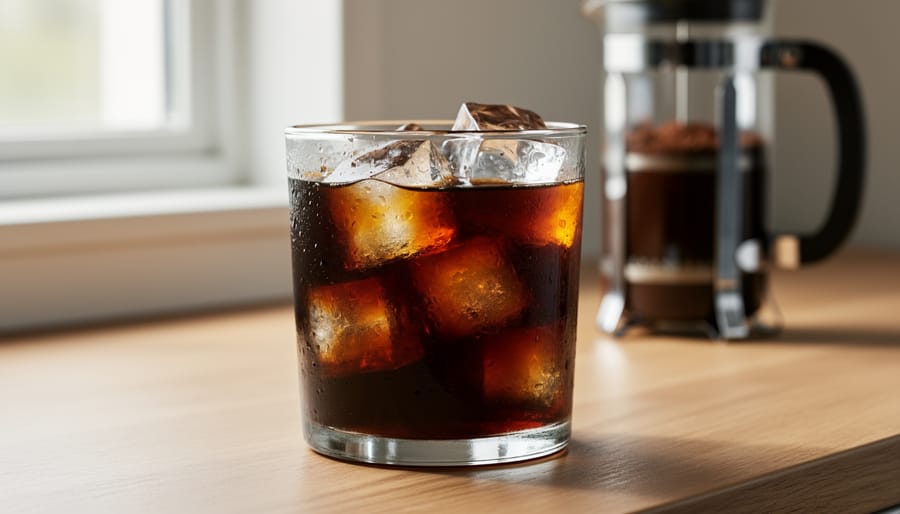
After 12 to 24 hours of steeping, your French press holds a concentrated brew that’s roughly twice the strength of ready-to-drink coffee. Pour the concentrate into a glass filled with ice, then dilute it with equal parts cold water or milk, a 1:1 ratio is a great starting point, though you can adjust to taste. Some coffee lovers prefer a stronger cup at 2:1 concentrate to water, while others stretch it to 1:2 for a lighter, more refreshing drink. Taste as you go and find your sweet spot.
Store any leftover concentrate in an airtight container in the refrigerator for up to two weeks. The cold environment preserves the smooth, mellow flavors you worked to extract. Pour individual servings as needed, diluting fresh each time to maintain the best taste and aroma. This approach gives you café-quality cold brew on demand without repeating the full brewing process daily.
Safety and Best Practices
Cold brew concentrate is a food product that needs proper handling to stay safe and delicious. The biggest risk is mold growth, which can develop if your French press or storage container isn’t thoroughly clean. Wash your French press with hot, soapy water immediately after each use, paying special attention to the mesh filter where coffee oils and fine particles accumulate. Disassemble the plunger completely every few brews to scrub each component, as residue trapped in crevices creates an ideal environment for bacteria and mold.
Store your finished concentrate in a clean glass container with a tight-fitting lid rather than leaving it in the French press, which isn’t designed for long-term refrigeration. Glass won’t absorb coffee oils or odors like plastic can, and it’s easier to verify cleanliness. Keep your cold brew on a middle or upper refrigerator shelf where temperature stays most consistent, away from raw foods that could cause cross-contamination if spills occur.
Handle glass French presses with care, especially when they’re wet and slippery. Never force the plunger if it meets significant resistance during cold brew, this usually means your grind was too fine or grounds have compacted. Stop, stir gently to loosen the bed, and try again with slow, steady pressure. Forcing it risks cracking the glass or spraying coffee grounds everywhere.
If you’re adding milk or homemade coffee creamer to your diluted cold brew, pour only what you’ll drink immediately rather than mixing it into your entire batch of concentrate, since dairy drastically shortens shelf life.
How to Know Your Cold Brew Is Perfect: Verification Tips
Your cold brew is ready to evaluate once you’ve pressed the plunger. Pour a small amount into a clear glass and hold it up to the light. Properly brewed cold brew concentrate should have a deep, rich brown color, think dark chocolate rather than black coffee. The liquid should appear relatively clear with minimal cloudiness or floating particles. If it looks murky or has visible grounds swirling around, your grind was likely too fine.
Now for the taste test. Dilute your concentrate with water or milk at roughly a 1:1 ratio to start, you can always adjust. The first sip should feel smooth and mellow, almost velvety on your tongue. You’re looking for a naturally sweet, chocolatey flavor with low acidity and zero harsh bitterness. If it tastes watery or weak, your coffee-to-water ratio was too diluted or your steep time too short. Next batch, either add more coffee grounds or extend steeping closer to the 24-hour mark.
Bitter, astringent cold brew signals over-extraction. You likely steeped past 24 hours or ground too fine, allowing excess surface area contact with water. Pull back your steep time to 12-16 hours and check your grind, it should resemble coarse sea salt, not fine sand.
Sediment at the bottom of your cup is normal in small amounts, but excessive grit means your French press filter needs cleaning or your grind size needs adjustment. A quick second pour through a fine-mesh strainer solves this immediately.
Once you nail the balance, smooth body, clean finish, pleasant sweetness, you’ve mastered the method. Cold brew concentrate keeps refrigerated for up to two weeks, so you can enjoy it straight, over ice, or even mixed into a chai latte for variety. Trust your palate and adjust one variable at a time until each batch tastes consistently excellent.
Expert Tips from Coffee Professionals
Veteran baristas consistently recommend medium roasts for cold brew in a French press because they deliver balanced sweetness without the flatness that can emerge from dark roasts when extracted slowly at room temperature. Light roasts work if you enjoy bright acidity, but extend your steep closer to 24 hours to pull enough body from the beans.
Single-origin coffees reveal their character beautifully in cold brew. Ethiopian beans bring floral and citrus notes, Colombian origins offer caramel and nutty undertones, and Brazilian coffees contribute chocolate richness. Buy whole beans roasted within the past two weeks and grind them just before brewing, stale coffee amplifies the dull, cardboard notes that cold extraction can’t mask.
Here’s an insider trick: bloom your grounds first. Pour just enough cold water to saturate the coffee, stir gently, wait two minutes, then add the remaining water. This brief pre-soak releases trapped CO2 and encourages more even extraction, producing a cleaner cup with less sediment.
For flavor customization, add a cinnamon stick, vanilla bean, or a few cardamom pods directly to the French press before steeping. These aromatics infuse subtly over the long brew time without overpowering the coffee’s natural profile. Once you’ve mastered the base recipe, exploring coffee pairing with cold brew opens up creative serving possibilities that highlight different flavor dimensions.
Finally, invest in a quality burr grinder. Blade grinders produce uneven particles that lead to simultaneous over-extraction and under-extraction, muddying your cold brew’s clarity and balance.
Common Questions About French Press Cold Brew
Can I use regular grind coffee for French press cold brew?
No, you need a coarse grind specifically. Regular or fine grinds will over-extract during the long steep time, creating bitter flavors and making the plunger nearly impossible to press. They’ll also pass through the mesh filter, leaving sediment in your cup.
How long does cold brew last in the refrigerator?
Properly stored cold brew concentrate stays fresh for 7-10 days in an airtight container in the fridge. The flavor is best within the first five days, but it remains safe to drink for up to two weeks if kept cold and sealed.
Is cold brew stronger than regular hot coffee?
Cold brew concentrate is stronger by volume, but when diluted properly it has similar caffeine levels to hot coffee. The concentrate uses a 1:5 ratio, which you then dilute with water or milk, while hot coffee typically brews at 1:16 directly.
What’s the difference between 12 and 24 hour steep times?
A 12-hour steep produces lighter, more delicate flavors with bright notes, while 24 hours extracts deeper, richer flavors with more body. Start at 12 hours and taste-test batches to find your preference, most people settle around 16-18 hours.
Beyond these basics, readers often wonder if their French press needs special features for cold brew. The good news: any standard French press works perfectly. You don’t need a dedicated cold brew maker or modified plunger system. The mesh filter that works for hot coffee handles cold brew beautifully, and the glass or stainless carafe has no trouble with 12-24 hours of refrigeration.
Another common question involves reusing grounds. Don’t do it. Cold brew already extracts less caffeine and flavor compounds than hot brewing because of the low temperature, so used grounds have almost nothing left to give. You’ll end up with weak, flavorless liquid that wastes your time and fridge space.
For those exploring different brewing methods, French press cold brew sits between immersion brewers like the Toddy system and slow-drip towers. It’s simpler and more affordable than dedicated cold brew makers, easier to clean than bag-and-bucket methods, and produces comparable quality to systems costing ten times more. The trade-off is slightly more sediment than paper-filtered methods, but most coffee lovers appreciate the fuller body this creates.
If you’re serious about experimenting with different beans for cold brew, investing in one of the best coffee roasters lets you control freshness and roast profiles specifically for cold extraction. Lighter roasts highlight origin characteristics that shine in cold brew, while you can pull medium roasts slightly early to preserve the fruit-forward notes that long steeping loves.
The strength question deserves one final note: you control potency entirely through your dilution ratio. Keep concentrate undiluted for an intense coffee experience, cut it 1:1 with water for standard strength, or go 1:2 for a mellower cup. There’s no wrong answer, just personal preference.
Making cold brew coffee in a French press isn’t just convenient, it’s genuinely one of the most forgiving and flexible brewing methods you can master. You don’t need specialized equipment, expensive gadgets, or barista-level precision to produce smooth, low-acid coffee that rivals anything from a specialty café. With just your French press, coarse-ground beans, cold water, and a bit of patience, you’re equipped to brew exceptional cold brew concentrate that’ll transform your morning routine.
The beauty of this method lies in its adaptability. Start with the 1:5 ratio and 12-hour steep time we’ve outlined, then adjust based on your taste preferences. Maybe you’ll discover you prefer a 16-hour steep for deeper flavor, or a slightly lighter ratio for ready-to-drink cold brew. Some mornings call for bold cold brew over ice, while others might pair better with a matcha latte for variety.
Don’t overthink it, grind some beans tonight, add cold water, and let your French press work its magic while you sleep. Tomorrow morning, you’ll press the plunger and pour yourself proof that great coffee doesn’t require complexity.