
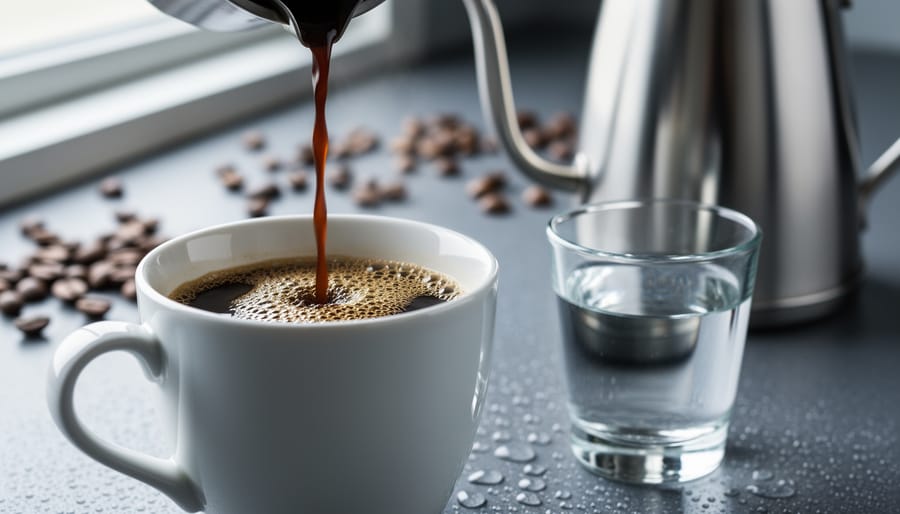
Water quality’s effect on coffee taste refers to how the mineral content, pH level, and purity of brewing water chemically interact with coffee compounds during extraction, fundamentally altering flavor, aroma, and body in the cup. Your water isn’t just a neutral carrier. It’s an active ingredient that can either highlight bright, complex notes or mute them into flat, bitter, or sour disappointment.
Most coffee drinkers obsess over bean origin, roast profiles, and grind size, yet overlook the liquid that makes up 98% of their brew. The chemistry is straightforward: minerals like calcium and magnesium act as binding agents, pulling desirable flavors and oils from coffee grounds. Too little mineral content leaves extraction weak and sour. Too much brings harsh bitterness and chalky mouthfeel. Chlorine, heavy metals, and high pH skew everything further, masking the nuanced sweetness and acidity roasters spend months perfecting.
This article breaks down exactly how water composition drives extraction chemistry, categorizes common water types and their flavor signatures, and translates that science into practical steps you can take at home. We’ve tapped insights from specialty roasters and baristas who treat water as seriously as their espresso machines, plus explored real-world solutions from filtration to Pacific Springs water delivery for consistent results. Whether you’re troubleshooting a mysteriously off pot or chasing café-quality espresso, understanding your water is the fastest fix you’re not making yet.
What Water Quality Actually Means for Coffee
When coffee professionals talk about water quality, they’re measuring five specific factors that chemistry can pin down with numbers. Unlike vague terms like “good water” or “clean water”, these metrics tell you exactly what’s dissolved in your H₂O and how it’ll interact with coffee grounds.
The most important measurement is Total Dissolved Solids, or TDS. This number (measured in parts per million, or ppm) tells you how much mineral content your water carries. Think of it as the water’s “flavor capacity.” Too low, and the water can’t grab enough compounds from the coffee. Too high, and it brings its own mineral taste that muddles the brew. The Specialty Coffee Association recommends 75-250 ppm for optimal extraction.
- TDS (Total Dissolved Solids)
- The total concentration of minerals, salts, and organic matter dissolved in water, measured in parts per million (ppm). For coffee, the sweet spot sits between 75-250 ppm.
- Water Hardness
- The amount of calcium and magnesium in your water. Hard water (high mineral content) can over-extract and create chalky flavors, while soft water may under-extract and taste flat.
- pH Level
- A scale from 0-14 measuring acidity or alkalinity, with 7 being neutral. Coffee brews best with water between 6.5-7.5 pH; outside this range, extraction goes wonky.
- Alkalinity
- The water’s ability to neutralize acids, acting as a buffer. High alkalinity can mute coffee’s natural brightness and acidity, flattening the cup’s complexity.
- Chlorine/Chloramine
- Disinfectants added by municipal water systems. Even trace amounts create chemical off-flavors that overpower coffee’s subtle notes, especially in lighter roasts.
Water hardness specifically measures calcium and magnesium levels. These minerals matter because they’re the primary extraction agents, they literally pull flavor from coffee. But there’s a Goldilocks zone: some hardness is essential, but too much creates that chalky, bitter taste you might recognize from cheap diner coffee.
pH measures acidity or alkalinity on a scale from 0 to 14. Coffee itself is acidic, and your water’s pH changes how those acids taste in the cup. Water that’s too alkaline (above 8) will neutralize coffee’s bright, fruity notes. Water that’s too acidic (below 6) can amplify sourness into something unpleasant.
Then there’s chlorine, the chemical municipalities add to keep water safe. It’s fantastic for public health, terrible for coffee. Even a tiny amount creates a medicinal, swimming-pool taste that wipes out delicate flavor notes. This is why baristas are obsessed with filtration, not because they’re snobs, but because they’ve tasted what chlorine does to a $20 bag of single-origin beans.
Why does tap water vary so wildly from city to city? Your local water authority pulls from different sources, rivers, wells, reservoirs, each with distinct mineral profiles. Denver’s mountain runoff tastes nothing like Chicago’s Lake Michigan water or Phoenix’s heavily treated desert supply. When a coffee tastes incredible at a café in Seattle but flat when you brew the same beans at home in Miami, you’re often tasting the difference in water, not your brewing skills.
How Water Quality Works to Extract Coffee Flavor
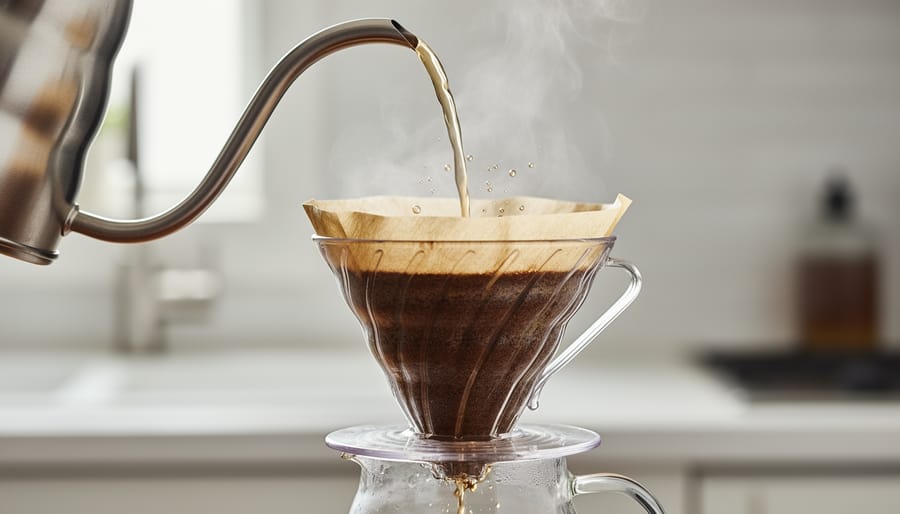
When you brew coffee, you’re not simply adding water to grounds, you’re starting a chemical extraction process, and minerals in your water are the workhorses making it happen. Think of minerals like calcium and magnesium as tiny bridges that connect to flavor compounds trapped inside the coffee. These minerals carry positive charges that bind with the negatively charged organic acids, sugars, and aromatic oils in your grounds, pulling them into solution. Without enough minerals present, those flavor molecules stay locked in the spent coffee, and you end up with a weak, hollow cup.
This is exactly why distilled water, stripped of all minerals, produces such disappointing coffee. There are almost no carriers available to extract flavor, so you get a thin, lifeless brew that tastes more like brown water than coffee. Reverse osmosis water suffers the same problem unless you remineralize it afterward. Pure H₂O just can’t do the heavy lifting extraction requires.
On the flip side, balanced mineral content transforms extraction. Magnesium is particularly effective at grabbing fruity, bright acids like citric and malic acid, which is why water rich in magnesium brings out sweetness and complexity in lighter roasts. Calcium binds more readily with heavier, earthy compounds and contributes body to the cup. When both minerals exist in moderate amounts, you get a fuller spectrum of flavors, the brightness, the sweetness, the mouthfeel, all working together instead of one note dominating.
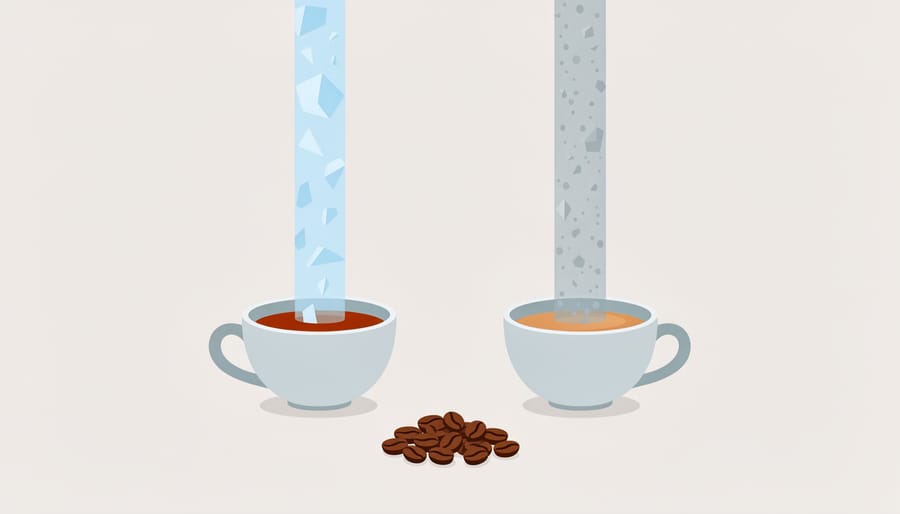
The optimal range for total dissolved solids sits between 75 and 250 parts per million. Below 75 ppm, you don’t have enough minerals to extract thoroughly, leaving potential flavor behind. Above 250 ppm, you risk over-extraction and harsh, bitter notes as too many minerals pull compounds indiscriminately. That sweet spot allows selective extraction: enough mineral presence to capture the desirable flavors without dragging out the unpleasant ones.
Temperature plays a supporting role here, but it’s the mineral composition doing the real work. Hot water speeds up the process, but minerals determine which compounds actually make it into your cup. If your water chemistry is off, no amount of precise temperature control will save the brew.
Different Types of Water and Their Coffee Impact
Not all water is created equal when it comes to coffee brewing. The type you choose directly shapes what ends up in your cup.
Tap water is what most home brewers use by default, and its quality varies wildly depending on your municipality. Some cities supply beautifully balanced water that makes excellent coffee straight from the faucet. Others deliver heavily chlorinated water with high mineral loads that produce harsh, metallic cups. If your tap water tastes good on its own, it’ll probably make decent coffee. If it smells like a swimming pool or leaves chalky deposits, your coffee will suffer accordingly.
Filtered water removes the worst offenders, chlorine, sediment, and some contaminants, while leaving helpful minerals intact. A basic carbon filter pitcher or faucet attachment can transform mediocre tap water into something quite serviceable for brewing. This is the sweet spot for most home setups: minimal effort, noticeable improvement, and it works equally well whether you’re pulling espresso shots or making French press cold brew.
Bottled spring water brings naturally occurring minerals from underground sources. The mineral profile varies by brand, so one spring water might highlight brightness and acidity while another emphasizes body and sweetness. Many specialty cafés test different brands to find their ideal match. Just read the label for TDS, you want something in that 75-250 ppm range, not mineral water marketed for health benefits with sky-high TDS.
Distilled or reverse osmosis water strips out virtually everything, including the minerals coffee needs for proper extraction. Pure H₂O sounds appealing, but it produces flat, underwhelming coffee lacking depth and complexity. The total absence of minerals means fewer flavor compounds get pulled from the grounds. Think of it as trying to paint without a canvas.
Remineralized water solves the distilled water problem by starting with pure water and adding back specific minerals in controlled amounts. This is what serious competitors and third-wave shops often use, it’s essentially custom-built water tailored to their beans and brewing methods. You can buy mineral packets to create your own recipes at home, though it requires more commitment than most casual brewers want to invest.
Real-World Applications: When Water Quality Makes or Breaks Your Brew
Expert Take: What Professional Baristas Do About Water
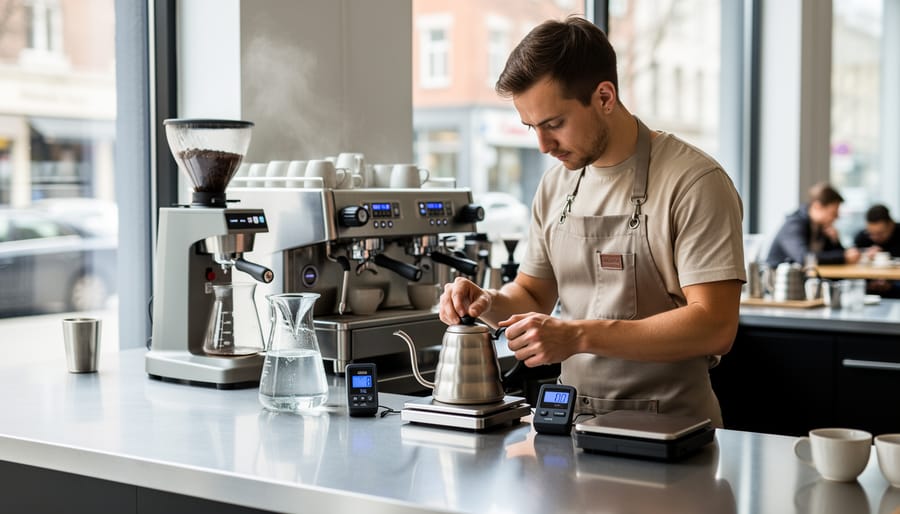
I spoke with Sarah Chen, head barista at Portland’s Ember Collective, about what goes into their water system. “We test TDS weekly and recalibrate our filtration quarterly,” she told me. “Most customers don’t realize we spend more on water treatment than we do on our grinder maintenance.” Her shop runs a three-stage system: sediment filter, carbon block, then remineralization to hit 150 ppm with a 2:1 calcium-to-magnesium ratio.
Marcus Webb, who trains baristas across the Southeast, put it bluntly: “You can dial in the perfect shot on a $15,000 espresso maker but if your water’s off, you’re just making expensive mud.” He carries a handheld TDS meter everywhere and says the first thing he checks when troubleshooting a café’s inconsistent shots is their water source.
The obsession makes sense when you consider the stakes. Third-wave shops built their reputations on showcasing subtle flavor notes, the kind that dissolved minerals can either reveal or obliterate. Some high-end cafés bypass local water entirely, using super-automatic machines with built-in purification or installing dedicated RO systems with custom mineral blends. “It’s not about being precious,” Sarah added. “It’s about control. We can’t change the weather or the harvest, but we can absolutely control what comes out of our tap.”
Common Questions About Water and Coffee Taste
Does boiling tap water improve its quality for coffee?
Boiling kills bacteria and removes some chlorine through evaporation, but it doesn’t reduce mineral content or heavy metals, and it can actually concentrate minerals by evaporating water. If your main issue is chlorine taste, boiling helps slightly, but a simple carbon filter is far more effective.
Can I actually taste the difference in a blind test?
Most coffee drinkers can detect differences when water quality varies significantly, especially with lighter roasts that highlight nuance. The contrast between hard tap water and filtered water is usually noticeable, muddled bitterness versus clean sweetness, though individual sensitivity varies.
Is expensive bottled water worth it for coffee?
Not necessarily. Many premium bottled waters have too few minerals for good extraction, while some affordable spring waters work beautifully. What matters is balanced mineral content (75-250 ppm TDS), not price, a $1 gallon of the right spring water often beats $4 imported bottles.
How do I test my water at home?
Basic TDS meters cost $10-15 online and give you mineral content readings in seconds. For deeper analysis, aquarium test strips measure hardness and pH for a few dollars, or send a sample to Ward Labs for comprehensive testing (around $30) if you’re serious about optimization.
What’s the cheapest way to improve water quality?
A simple pitcher filter like Brita removes chlorine and some impurities for pennies per gallon, the biggest bang for your buck if you currently make coffee at home with straight tap water. It won’t perfectly balance minerals, but it eliminates the worst offenders that ruin taste.
Do coffee shops really use special water systems?
Absolutely. Third-wave cafés typically install multi-stage filtration and softening systems costing thousands of dollars, often with remineralization to hit exact specifications. They treat water as seriously as espresso machine maintenance because inconsistent water ruins even the best beans and brewing technique.
Will fixing my water solve all my coffee problems?
Water quality is one critical variable, but it works alongside fresh beans, proper grind size, correct ratios, and technique. If you’re already doing everything else right but your coffee tastes flat or harsh, water is likely the missing piece, but it’s not a magic fix for stale beans or poor brewing fundamentals.
The answers above reflect what specialty coffee professionals have learned through years of troubleshooting flavor issues. Water often flies under the radar because it seems too basic to matter, yet it’s the solvent doing all the extraction work. You don’t need lab-grade precision to see improvement, most home brewers notice clearer, sweeter cups just by filtering out chlorine and balancing mineral extremes. Start with the simplest intervention that addresses your water’s specific issue, taste the difference, then decide whether further refinement makes sense for your setup and palate.
So how important is water quality to the taste of your coffee? Turns out, monumentally. We’ve seen how water’s mineral composition drives extraction, how different water types produce wildly different cups, and how even professionals obsess over getting it right. Here’s the best part: upgrading your water is probably the cheapest, easiest improvement you’ll make to your coffee. You don’t need a new grinder or expensive beans to taste the difference. Start simple, try filtered water versus tap, or experiment with bottled spring water. Treat water as an ingredient, not just something wet to pour over grounds. Once you dial it in, you’ll unlock flavors you didn’t know your coffee had. That attention to detail pairs beautifully with other aspects of the craft, like exploring coffee pairing. Go ahead, brew the same beans with different water. Your palate will thank you.